Clustering strategies
Clustering groups cells by their poly(A) site (PAS) usage patterns so that
downstream differential APA tests have biologically meaningful contrasts. The
input to every clustering strategy is an AnnData object whose rows are cells
and whose columns are PAS peaks (cells x PAS). The output is the same AnnData
with obs["leiden"] populated and obsm["X_umap"] computed for visualization.
Each strategy implements three internal phases executed by the orchestration
layer in ema/clustering/clustering.py: normalize, reduce_dims, and
cluster. Researchers interact with the strategy only through CLI flags or
YAML keys; the three-phase split is an implementation detail.
leiden_tfidf
Question: Which groups of cells share a similar pattern of poly(A) site usage across the transcriptome, treating each PAS as a "word" and each cell as a "document"?
Algorithm
- Compute total read counts per cell and store in
obs["total_counts"]. - Apply Signac Method 1 TF-IDF: for each cell-PAS entry,
TF = count / cell_totalandIDF = n_cells / cells_with_this_PAS. The transformed value islog1p(TF * IDF * scale_factor). - Run Truncated SVD (randomized algorithm) to produce an LSI embedding of shape (n_cells, n_components). L2-normalize each row.
- Remove LSI components whose Pearson |r| with total read counts exceeds
depth_corr_threshold. This is the ArchR-style depth-correlation filter that prevents sequencing depth from driving cluster separation. - Build a cosine-distance k-nearest-neighbor graph on the filtered LSI
embedding using
n_neighborsneighbors acrossn_dimsdimensions. - Run UMAP for 2-D visualization and Leiden community detection
(flavor=
igraph,n_iterations=2, undirected) at the specifiedresolution.
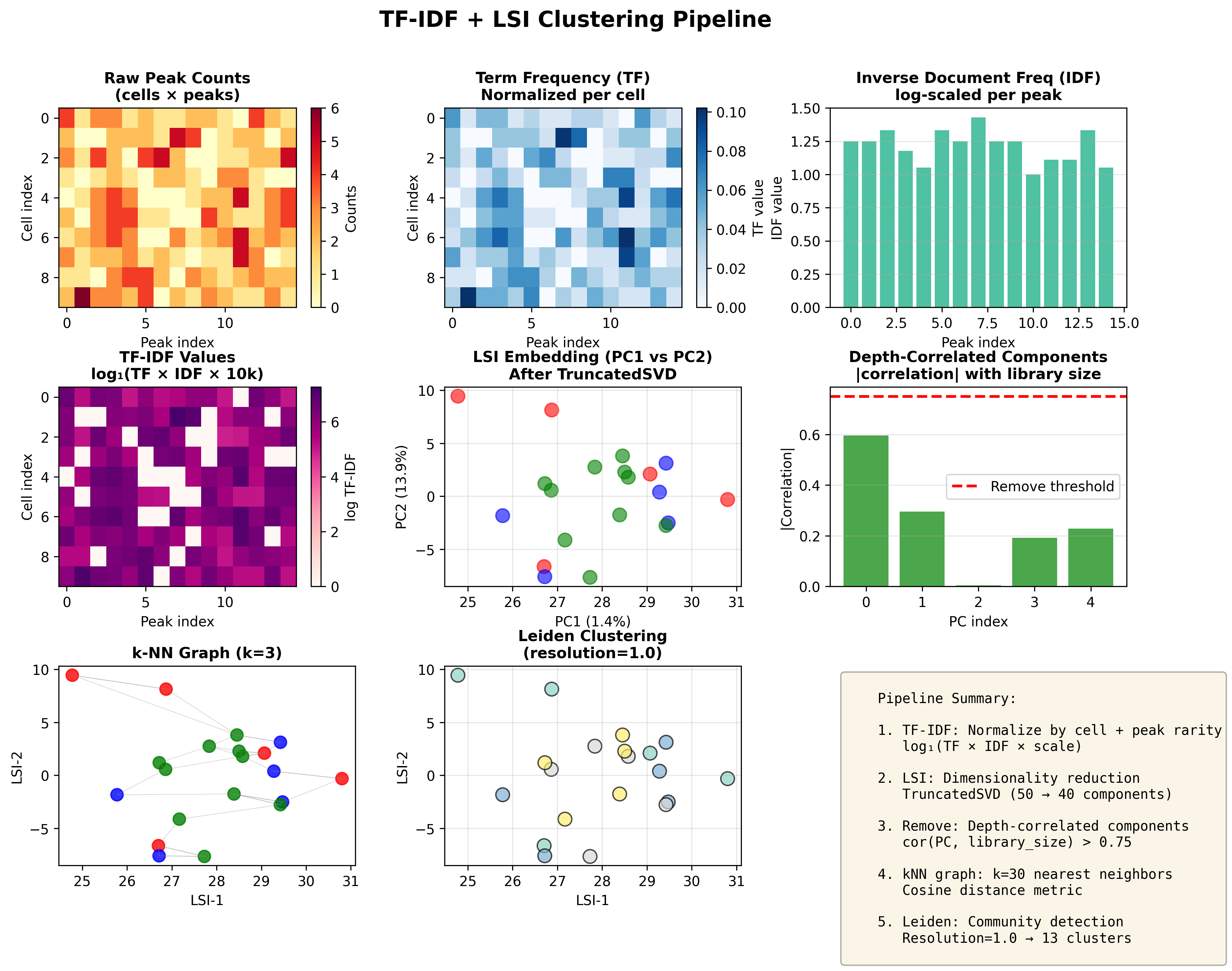
The six steps above, on a deliberately tiny illustrative matrix (15 PAS ×
10 cells) so each transform stays readable: raw counts → per-cell TF → per-PAS
IDF → log1p(TF × IDF × scale) → the LSI embedding → the depth-correlation
filter (components whose |r| with library size exceeds
depth_corr_threshold, 0.75, are dropped) → the cosine k-NN graph → Leiden
communities. The matrix is synthetic; the panel exists to show the transforms,
not to report a result.
Inputs and outputs
Inputs:
- AnnData with
X= sparse (cells x PAS) count matrix - Requires at least 3 cells and 3 PAS (raises
ValueErrorotherwise)
Outputs stored in AnnData:
| Key | Location | Content |
|---|---|---|
total_counts |
obs |
Pre-normalization read sum per cell |
X_lsi |
obsm |
L2-normalized LSI embedding after depth-correlation filtering |
lsi_kept_components |
uns |
Array of component indices that passed the filter |
lsi_variance_ratio |
uns |
SVD explained variance ratios |
leiden |
obs |
Cluster label strings |
X_umap |
obsm |
2-D UMAP coordinates |
Tunable hyperparameters
| Parameter | Default | CLI flag | YAML key | Description |
|---|---|---|---|---|
resolution |
1.0 | --resolution |
resolution |
Leiden resolution. Higher values produce more, smaller clusters. |
n_components |
50 | --n-svd-components |
n_svd_components |
SVD components computed before depth-correlation filtering. |
n_dims |
40 | --n-pcs |
n_pcs |
LSI dimensions passed to the kNN graph (must be <= n_components). |
n_neighbors |
30 | --n-neighbors |
n_neighbors |
kNN graph size. Larger values smooth cluster boundaries. |
scale_factor |
10000 | --tfidf-scale-factor |
tfidf_scale_factor |
TF-IDF scale factor. Adjust when counts have very different dynamic range. |
depth_corr_threshold |
0.75 | --depth-corr-threshold |
depth_corr_threshold |
Pearson |
random_seed |
42 | --random-seed |
random_seed |
RNG seed for SVD and Leiden. |
Interpretation
A well-formed result has clusters of varying sizes (not all cells in one
cluster, not every cell its own cluster). Inspect cluster_sizes and
umap figures. If you see one giant cluster and many singletons, lower
resolution. If clusters look random on the UMAP (neighboring cells in
different colors), raise n_neighbors or lower depth_corr_threshold.
The lsi_kept_components key in .uns tells you how many components
survived depth filtering. If fewer than 5 survive, your data may have
strong library-size confounding; try leiden_libsize instead.
Limitations
- PAS counts have higher dynamic range than scATAC (0-100+ vs 0-3). The
sublinear_tf=Trueapproach (log1p on the TF term) is implicit in the Signac Method 1 formula but does not fully account for very high-count PAS. - Leiden clustering is non-deterministic across versions of the
igraphC library even with a fixed seed. Userandom_seedfor reproducibility within a single software environment. - With fewer than ~200 cells, depth-correlation filtering may remove too many
components. Set
depth_corr_threshold=1.0to disable it.
leiden_libsize
Question: Which groups of cells share similar PAS usage, using the conventional scRNA-seq normalization pipeline?
Algorithm
- Library-size normalize each cell to
target_sum=10,000(CPM-equivalent), then applylog1p. - Select the top
n_top_hvghighly variable PAS usingmin_mean=0.005, max_mean=5, min_disp=0.3. Subset the matrix to these PAS. - Scale each PAS to zero mean and unit variance (capped at
max_value=10). - Run PCA to
n_compscomponents. - Build a Euclidean kNN graph on
n_pcsPCA dimensions withn_neighborsneighbors. - Run UMAP and Leiden (same settings as
leiden_tfidf).
Inputs and outputs
Inputs:
- AnnData with
X= sparse (cells x PAS) count matrix
Outputs stored in AnnData:
| Key | Location | Content |
|---|---|---|
X_pca |
obsm |
PCA embedding |
leiden |
obs |
Cluster label strings |
X_umap |
obsm |
2-D UMAP coordinates |
Tunable hyperparameters
| Parameter | Default | CLI flag | YAML key | Description |
|---|---|---|---|---|
resolution |
1.0 | --resolution |
resolution |
Leiden resolution. |
n_comps |
50 | --n-svd-components |
n_svd_components |
PCA components computed before the kNN step. |
n_pcs |
40 | --n-pcs |
n_pcs |
PCA components used for the kNN graph (must be <= n_comps). |
n_top_genes |
2000 | --n-top-hvg |
n_top_hvg |
Highly variable PAS selected before PCA. |
n_neighbors |
10 | --n-neighbors |
n_neighbors |
kNN graph size. |
random_seed |
42 | --random-seed |
random_seed |
RNG seed. |
Interpretation
This strategy uses a smaller default n_neighbors (10 vs 30) because PCA
Euclidean distances behave differently from cosine LSI distances in high
dimensions. If UMAP looks overly fragmented, raise n_neighbors to 20-30.
HVG selection can exclude informative PAS if n_top_hvg is too small. For
experiments with few cells (< 500), consider raising min_mean slightly or
disabling HVG selection by setting n_top_hvg to the full feature count.
Limitations
- Library-size normalization assumes all cells have similar total transcript
content. When cells differ dramatically in capture efficiency (a known
problem in poly(A) sequencing),
leiden_tfidfis preferred. - PCA is sensitive to outlier PAS with very high variance after scaling
(clipped at
max_value=10). Verify thepeak_qcfigure first.
external
Question: How do pre-computed cluster labels from a gene-expression analysis (Seurat, Scanpy, CellRanger) align with PAS usage patterns?
Algorithm
- Apply a light log-normalization (
normalize_total+log1p) solely to produce a meaningful UMAP for visualization. No dimensionality reduction drives the cluster labels. - Run PCA to up to 50 components for UMAP only.
- Load the user-provided CSV file: column 0 = cell barcode, column 1 = cluster label (no header expected).
- Match barcodes between the AnnData and the CSV. Cells with no matching
barcode receive the label
"unassigned". - Assign matched labels to
obs["leiden"]as a Categorical. - Build a kNN graph and compute UMAP for visualization.
Inputs and outputs
Inputs:
- AnnData with
X= sparse (cells x PAS) count matrix - CSV file at
labels_path: two columns (barcode, cluster), no header
CSV format:
Outputs stored in AnnData:
| Key | Location | Content |
|---|---|---|
leiden |
obs |
Cluster labels from CSV (or "unassigned") |
X_umap |
obsm |
2-D UMAP coordinates for visualization |
Tunable hyperparameters
| Parameter | Default | CLI flag | YAML key | Description |
|---|---|---|---|---|
labels_path |
required | --external-clusters |
external_clusters |
Path to the two-column CSV file. No default; the strategy raises ValueError if absent. |
random_seed |
42 | --random-seed |
random_seed |
RNG seed for UMAP. |
Interpretation
Cells labeled "unassigned" appear in the UMAP but are excluded from
differential APA tests. A high fraction of unassigned cells (> 10-20%)
usually means a barcode format mismatch (e.g., the CSV has sample_ACGT
while the h5ad uses ACGT-1). Check the barcode convention with
adata.obs_names[:5] vs the first column of the CSV.
Limitations
- Requires barcode-level overlap between the gene-expression clustering and the PAS count matrix. Barcodes are matched by exact string equality after AnnData loading; no prefix stripping is applied.
- UMAP computed from PCA on log-normalized PAS data will not necessarily match the UMAP from the source gene-expression analysis. Use it only as a layout for coloring by the imported labels, not for interpreting PAS structure.